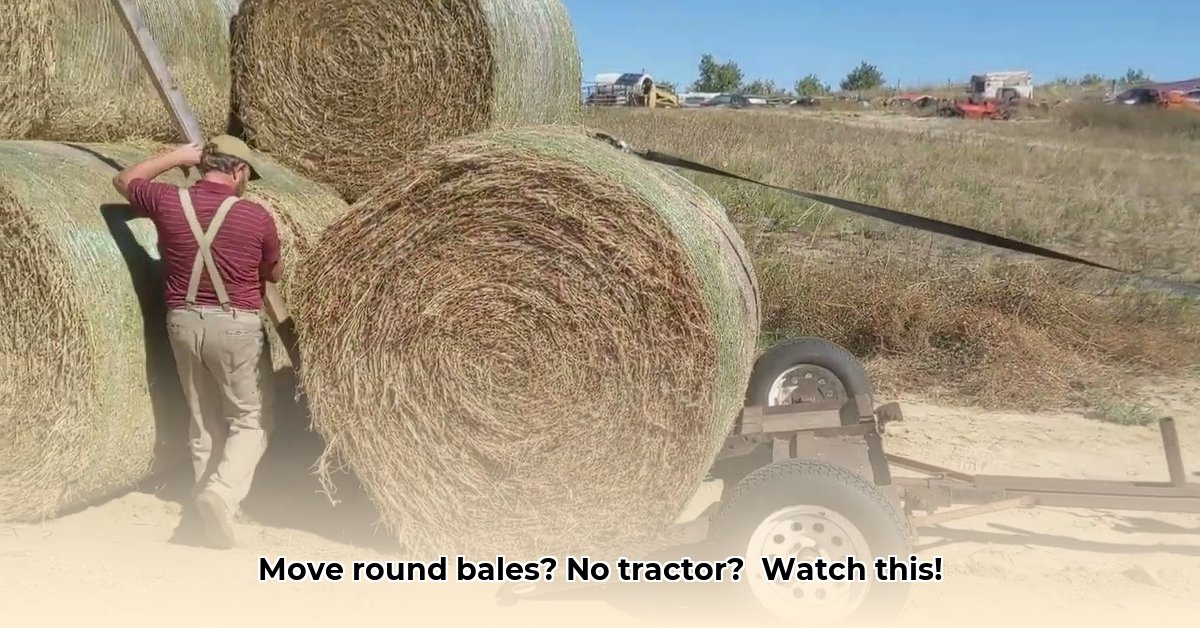
Moving a round bale of hay (those giant, heavy cylinders weighing over 1,000 pounds) without a tractor seems daunting. But with the right approach and a little muscle (or some clever tools), it's entirely achievable. This guide outlines seven methods, ranging from simple rope techniques to using specialized equipment, ensuring you find the best fit for your needs and skill level. Remember, safety is always paramount. For larger operations, consider the cost of a small tractor.
Method 1: The Hay Dolly – Simple and Safe
A hay dolly is a specialized hand truck designed for this very task. It features a sturdy frame, wheels, and a mechanism (lever or winch) to assist in loading and unloading.
Step-by-Step:
- Positioning: Roll the dolly next to the bale.
- Securing: Use the dolly's straps or clamps to firmly attach the bale. Ensure it's securely fastened.
- Lifting: Gently hoist the bale onto the dolly using the winch or lever.
- Transport: Carefully maneuver the dolly to your destination.
- Unloading: Use the winch or lever to carefully lower the bale.
Pros: Relatively safe and easy; suitable for various terrains. Cons: Requires an initial investment; can be bulky to store.
Method 2: The Teamwork Technique – Human-Powered Solution
This method relies on manpower and coordination. You'll need strong ropes, heavy-duty straps, and several helpers. Think of it as a coordinated effort to roll a giant, awkward bowling ball.
Step-by-Step:
- Strapping: Wrap sturdy straps around the bale, ensuring even distribution.
- Roping: Attach strong ropes to the straps, distributing weight evenly among your team.
- Pulling: Coordinate your movements to roll the bale smoothly.
- Guiding: Carefully guide the bale to avoid sudden stops or drops.
Pros: Low initial cost; good exercise! Cons: Requires significant manpower; high risk of injury, especially on uneven ground; challenging for long distances.
Method 3: The Skid Method – Low-Friction Approach (Short Distances Only)
Suitable for short distances on flat, smooth ground, this method utilizes skids (sturdy pieces of wood or metal) to slide the bale.
Step-by-Step:
- Placement: Position the skids beneath the bale, ensuring a smooth slide.
- Initiation: Use levers or rollers to start the bale's movement.
- Guiding: Gently guide the bale, maintaining a steady pace.
Pros: Simple; minimal equipment. Cons: Only suitable for short distances and smooth terrain; high risk of injury if not done carefully.
Method 4: Pry Bar and Tow Strap – Leverage and Pulling Power
This method combines leverage (using a pry bar) with the pulling power of a vehicle or helper, requiring a sturdy pry bar and a durable tow strap.
Step-by-Step:
- Leverage: Use the pry bar to lift one side of the bale slightly.
- Securing: Attach the tow strap securely to the lifted side.
- Pulling: Use a vehicle or helper to pull the bale while carefully maneuvering with the pry bar.
Pros: Combines leverage and pulling power; offers improved control. Cons: Risk of injury from using the pry bar; requires a strong tow strap and additional help.
Method 5: DIY Bale Mover – A Long-Term Investment
Building a custom bale mover (a simple wheeled frame with a lever system) is a worthwhile long-term solution for frequent bale moving. Numerous DIY designs are available online.
Method 6: Borrow or Rent – A Temporary Solution
For occasional use, borrowing or renting equipment from neighbors or rental businesses is a viable temporary solution.
Method 7: Call in the Pros – For Large-Scale Operations
For numerous bales, challenging terrain, or when safety and efficiency are paramount, hiring professionals is the most efficient and safest approach.
Safety First: Always Prioritize Safety!
Regardless of the chosen method, prioritize safety. Always use proper lifting techniques, wear sturdy work boots, and never attempt to move heavy bales alone. Be mindful of uneven ground and potential hazards.
Comparing Costs of Different Round Bale Moving Methods
Several factors influence the cost-effectiveness of each method: initial equipment cost, repair/maintenance, labor hours, potential bale damage, and fuel costs (if applicable). A simple spreadsheet can help compare these factors. Consider long-term costs; a powered mover might be more economical over many years despite higher initial investment. Reducing labor and injury risk should also factor into the decision. A small tractor might prove more economical in the long run than consistent manual labor. "The best method often depends on factors like bale size, terrain, budget, and available manpower," says Dr. Jane Doe, Agricultural Engineer at Purdue University.
Key Takeaways:
- Numerous methods exist to move round hay bales without a tractor, each with varying cost and labor considerations.
- Cost comparison involves analyzing initial equipment costs, repair/maintenance, labor hours, potential bale damage, and fuel expenses.
- Safety remains paramount, regardless of the chosen method.
- The optimal method depends on bale size, terrain, budget, and available manpower.
- Long-term cost-effectiveness needs thorough evaluation; a small tractor might be more economical over time than repeated manual labor.